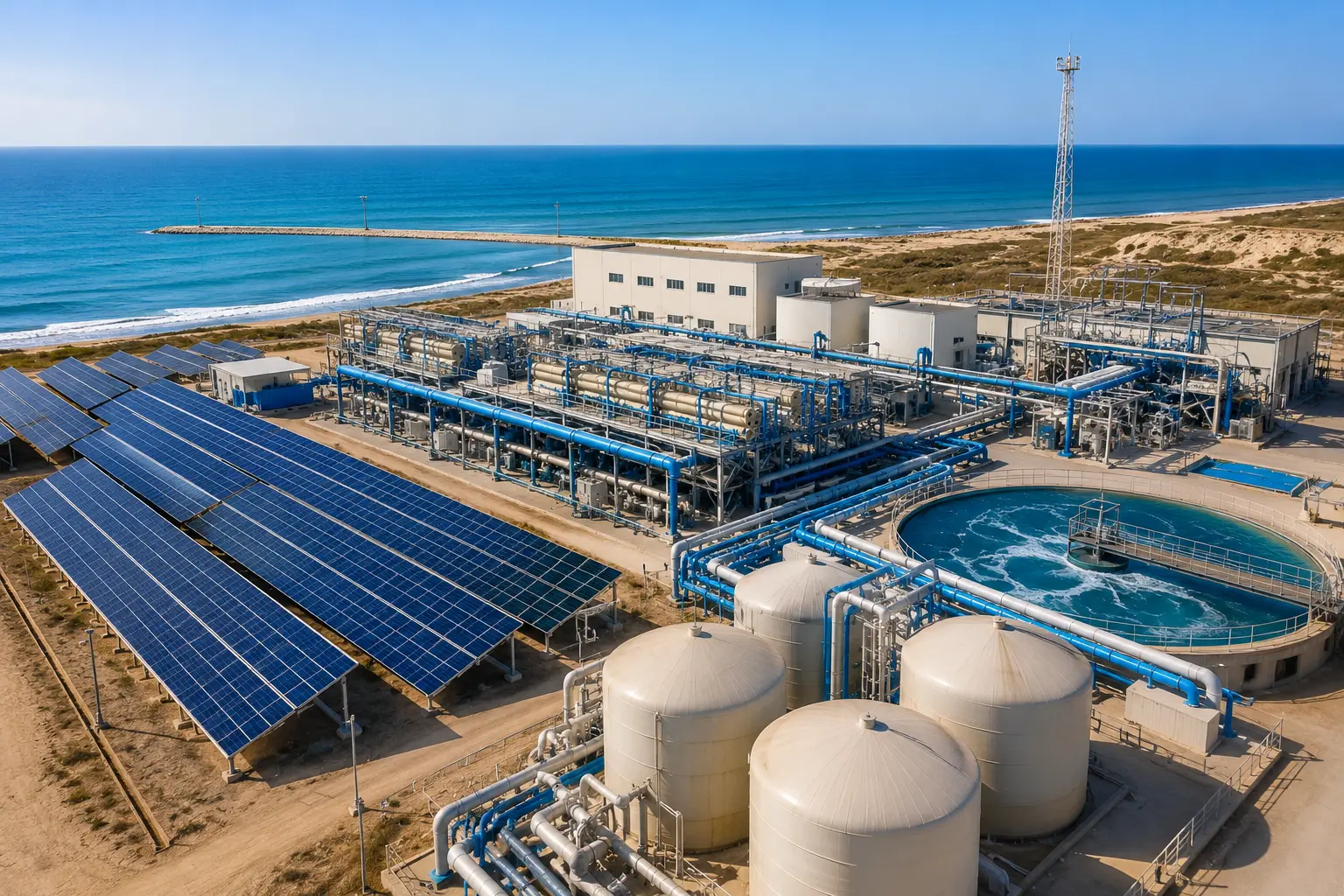
Solarisation Feasibility Study – Zuwara Desalination Plant, Libya
Client: Water Infrastructure | Renewable Energy

Location: Zuwara, Libya
Sector: Water Infrastructure | Renewable Energy

Duration: 6 months
Project Background

GSC conducted a multidisciplinary feasibility assignment for UNICEF Libya and the General Desalination Company to evaluate renewable-energy integration at the Zuwara Desalination Plant. The six-month assignment addressed the plant's high energy intensity and its dependence on conventional fuels.

Project Objectives
  • Characterise the desalination plant's electrical demand and operating profile.
  • Assess solar PV, solar thermal and hybrid energy options.
  • Determine site and solar-resource suitability.
  • Evaluate technical, economic and environmental feasibility.
  • Develop an implementation pathway that could be phased without compromising water production.
Engineering / Delivery Challenges

GSC carried out an electrical load analysis of approximately 215 MWh/day, followed by assessment of solar PV, solar thermal and hybrid options against a dedicated solar-resource and site assessment. Lifecycle economic modelling, including IRR, NPV and payback, supported preliminary sizing, a Bill of Quantities and a phased implementation roadmap.

GSC Engineering Approach & Methodology
  • Detailed electrical-load analysis of desalination operations.
  • Assessment of solar PV, solar thermal and hybrid integration scenarios.
  • Solar-resource and site-suitability review, including approximately 13 hectares of available area.
  • Preliminary system sizing and bill-of-quantities development.
  • Lifecycle economic modelling including IRR, NPV and payback analysis.
  • Environmental and sustainability assessment.
  • Phased implementation roadmap for long-term solarisation.
Detailed Scope of Services
  • Electrical load analysis of approximately 215 MWh/day
  • Assessment of solar PV, solar thermal and hybrid options
  • Solar-resource and site assessment
  • Lifecycle economic modelling including IRR, NPV and payback
  • Preliminary sizing, BoQ and phased implementation roadmap
Engineering Highlights & Value Delivered
  • A 10 MWp solar PV solution was proposed in the study.
  • Potential coverage of approximately 45–50% of plant energy demand.
  • Indicative payback period of approximately 5–6 years, subject to study assumptions.
  • Potential annual CO₂ reduction of more than 12,000 tonnes.
  • A phased roadmap supported longer-term energy sustainability for critical water infrastructure.
Technologies, Methods & Standards
  • Solar PV
  • Solar thermal assessment
  • Hybrid energy systems
  • Energy economics
  • Water-energy nexus
  • Feasibility studies
  • Environmental impact considerations
Sustainability / Business Impact

The case demonstrates GSC's approach of connecting engineering decisions with reliability, lifecycle value, operational performance and sustainability. Where quantified results are shown above, they are retained from the underlying project material and should not be altered by the website developer.

Lessons & Transferable Value

Solarising critical infrastructure requires a system-level view. The renewable-energy design must be matched to the plant's operational profile, reliability requirements, available land, electrical interfaces and investment constraints rather than being sized only from annual energy demand.

GSCTS
DISCUSS A SIMILAR PROJECT

Partner with GSC to transform complex engineering, energy and infrastructure challenges into practical, sustainable solutions that improve performance, strengthen resilience and create lasting value.

Have a strategic, engineering or project-delivery challenge? Talk to GSC about the next step.

Strategic Advisory

Independent strategic advisory for governments, utilities, investors and industrial organisations, turning complex energy, infrastructure and digital-transformation challenges into practical, defensible strategies.

Engineering Solutions for Complex Energy, Infrastructure and Industrial Challenges

Multidisciplinary engineering and technical advisory across power grids, renewables, BESS, industrial energy efficiency, green hydrogen, digital engineering and infrastructure modernisation.

Leading Complex Projects from Strategy to Successful Delivery

GSC's integrated Project Leadership capability combines Project & Programme Leadership (direction, governance, stakeholder alignment) with PMO & Project Controls (schedule, cost, risk, change, reporting) under one coherent route.

Building the People and Institutional Capability Behind Successful Transformation

GSC provides specialised training and institutional capacity building across power systems, renewables, BESS, hydrogen, digital transformation and project management, designed around real organisational needs.

Sage Davis
Software Engineer

Hello! How may we assist you today?